
Ramot Bet
In addition to being one of the biggest neighborhoods in Jerusalem, Ramot (Hebrew for “heights”) is also one of the most diverse. The six sections of Ramot differ wildly from one another, just as the 40,000 people who live there come from a wide variety of backgrounds. What they share is the panoramic view, because Ramot was built hundreds of meters above sea level. Ramot is one of the newer Jerusalem neighborhoods, as construction first began in the 1970s. The different sections of Ramot were built by different architects and for differing purposes. Ramot Aleph (or Ramot One) was built for families of moderate income. The result is an area of attached, tiered apartment buildings, which together resemble a giant beehive.
Residents of these apartments tend to be Orthodox Jews with large families, even though the apartments themselves are not that big. In sharp contrast, Ramot Bet (Ramot Two) boasts rows of spacious private homes. Living in a private house, and in particular an unattached house, is a luxury in Jerusalem, where the majority of people live in apartments.
Ramot Bet is therefore known as a prosperous neighborhood, populated mainly with a mix of Modern Orthodox and secular Jews. Many English-speaking immigrants choose to live in Ramot Bet, since the lifestyle is similar to that which they left behind. The remaining four neighborhoods of Ramot present variations of the spectrum between these two extremes.
Ramot Six, for example, is comprised of private homes, but most of these are attached and not as large as the houses in Ramot Bet.
Ashkelon
Ashkelon is one of the most highly regarded cities in Israel, with roughly 149,000 residents and a population is that is constantly growing. This dynamic city boasts a high quality of life, with excellent educational institutions, rich and varied leisure activities for the entire population with many recreation spots located around the city. Ashkelon is just south of Ashdod and about one hour’s drive from Jerusalem. You’ll find a beautiful Sea Park located on Delilah Beach, next to the marina with its new large commercial center, cinema, cafés, and restaurants. In Tel Ashkelon National Park, you can enjoy an entertainment and camping experience with a view of the Mediterranean Sea. Ashkelon is a place where past and present blend perfectly into a modern, groundbreaking and progressive city, with a blended mix of Jews at all levels living together. This warm and wonderful community will always welcome you. Living in a beautiful city, inside and out make Ashkelon a place that it’s easy to fall in love with.
Tzfat
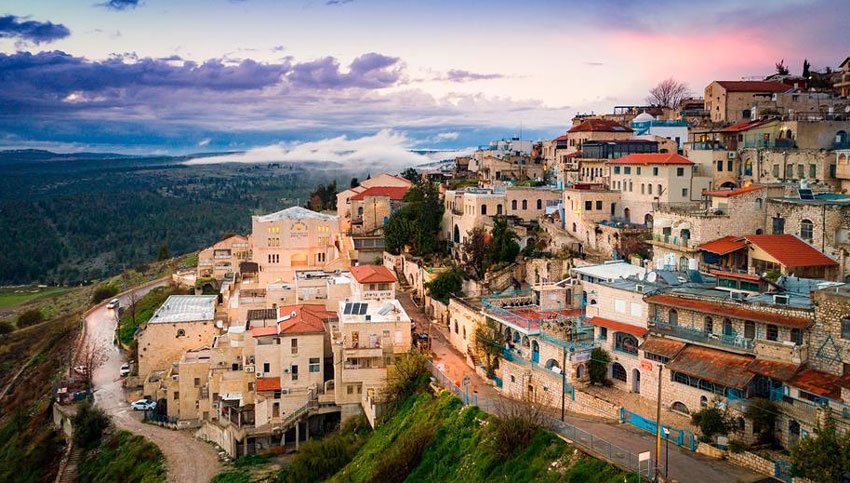
Tzfat is not only one of Israel’s holiest cities, it is also the highest city in the Holy Land. Set in the dense pine forests of the Upper Galilee, overlooking Tiberias and the Sea of Galilee, Tzfat is a delicious blend of ancient grandeur and modern-day resort. For thousands of years, the ancient city of Safed was conquered and reconquered – always changing hands. Said to have been founded by one of Noah’s sons after the Great Flood, the city was inhabited by the local Semetic populations throughout the years. Josephus mentions Tzfat as Sepph, a fortified Jewish town in the Upper Galilee. Today, after years of conflict ranging from the Crusaders to the Mamlukes to the British, Tzfat survives – as pretty, vibrant and mystical as ever!
Tel Mond
Founded over 80 years ago, Tel Mond has developed into a unique suburb with both religious and secular residents. Located in the heart of the Sharon region, Tel Mond is home to a vibrant and active Anglo community. Residents of Tel Mond benefit from being only kilometers away from high-tech job opportunities, shopping centers, and the beach, while also being able to enjoy the calm and luxury of living in a suburban community. Commutable to Tel Aviv and Netanya makes this a very attractive location.
Efrat
Considered the capital of Gush Etzion, it had a population of 10,806 in 2019. Modern Efrat was established in 1983 by Moshe Moskovits, who became the first mayor of Efrat and Shlomo Riskin, an Orthodox rabbi from New York City who settled in Efrat and became its Chief rabbi.
Efrat’s population are mainly religious Zionist, with a small number of ultra-orthodox and of non-observant residents. There are more than twenty Orthodox synagogues, mainly Ashkenazi, but a Sephardi and a Yemenite synagogue also exist and there are several Yeshivot, and Kollelim. The population includes native-born Israelis, and immigrants who have made aliyah from the United States, United Kingdom, Australia, France, South Africa, Argentina, The Netherlands, Canada, and Russia.
Efrat is made up of seven neighborhoods named for the Seven Species: Rimon (pomegranate), Te’ena (fig), Gefen (grapevine), Dekel (date palm), Zayit (olive), Tamar (date), and Dagan (grain – symbolizing both wheat and barley).
Kiriyat Hasharon
Kiyrat Hasharon is a new and very pleasant neighborhood to live in, part of the City Hall of Netanya. It has only been around for a little over fifteen years. A few years ago almost no one knew of its existence. It had to be said that you lived next to the Academy this academy frequently receives French speakers. For example: Alain Finkielkraut the famous philosopher who no longer needs to be presented. It also has a section for French and English speaking students. Today, having developed strongly, this district has become very popular. It is located 5 to 8 minutes from the beach and the Hastmaout kikar by car and 30 minutes on foot. A train station is also accessible on foot which is important if one has to work in Tel Aviv in Ramat Gan or even in Haifa. The many advantages of Kiryat Hasharonis that living in a quiet area where children can play outside without problems while having all means of transport and sports nearby. But there are many others. The prices of rents or apartments are lower both at the seaside and in Netanya center.