
Rehovot
Rehovot is home to the world famous Weizmann Institute of Science, the Robert H. Smith Faculty of Agriculture, Food & Environment (HUJI) and various hi-tech and biotech businesses that define the character of this “science-centric” modern city. Home to two academic institutes in addition to universities like Bar-Ilan and Tel-Aviv, Rehovot has adopted a young, trendy “University town” vibe. The ongoing influx of visiting academics from abroad helps to infuse the city with a truly international flavor.
A third of the population is religious, and 21% have an academic education. The city has a wonderfully warm Anglo Orthodox community with many shuls and kosher food establishments.
Pardes Chana
It’s not exactly in the north of the country, nor in the center. Maybe that’s what makes Pardes Channa in the northern Sharon region a place where each person can be whatever he or she wants. On the one hand, the town has filled up in recent years with city people from Tel Aviv, Ramat Hasharon and other cities in central Israel who came here for the dream of a country home, a garden and a family dog—despite the early morning traffic jams on Israel’s coastal road. On the other hand, Pardes Hanna has become a place for beatniks and artists who have discovered a place to create, to launch initiatives, and enjoy a rich community life. Amid this modern-day influx, let’s not forget the veterans of ‘Moshava HaYekkim’ (1929), who grew up under the patronage of Baron de Hirsch (“The Known Benefactor”), and of Karkur (1913), who preserved the character of Arab landholders from the Ottoman period. Here we see a dynamic mix of old and new, longstanding and new young residents, artists and common people. Something in this human patchwork seems to be going quite well. This town with its seemingly endless tiny roads and its 43,000 residents somehow still refuses to become a city. Maybe it’s due to the prestige of remaining a ‘local council’, or maybe due to the bureaucracy involved.One way or another, Pardes Channa (named for Hannah Rothschild, the niece of Baron de Hirsch) is marking 90 years since its founding and 50 years since its union with Karkur in 1959. “So why does everyone call it “Pardes Canna” rather than “Pardes Channa-Karkur”? Irit Oren, director of the Veteran’s House, explains: Both communities have strong sentiments for their past and neither wants to surrender its classic name. Pardes Channa was once considered the “spoiled younger sister” due to the philanthropy of the Baron while Karkur’s roots go back to an English association founded on capital and entrepreneurship that, surprisingly, succeeded during hard times in Israel. Neither really wanted the other, but just like today’s political rivals in Israel they understood that two is stronger than one.
Maalot
Looking for your home in Israel and considering the north? Maalot, located 20 minutes east of Nahariya, has a warm Anglo, Torani commuity with affordable homes and new building projects. Hear from the locals including Marci Eskenazi our new Real Estate Broker and her husband David from Aliyah Network, all about the community! Schedule a Real Estate overview to find out what’s possible.
Tzfat
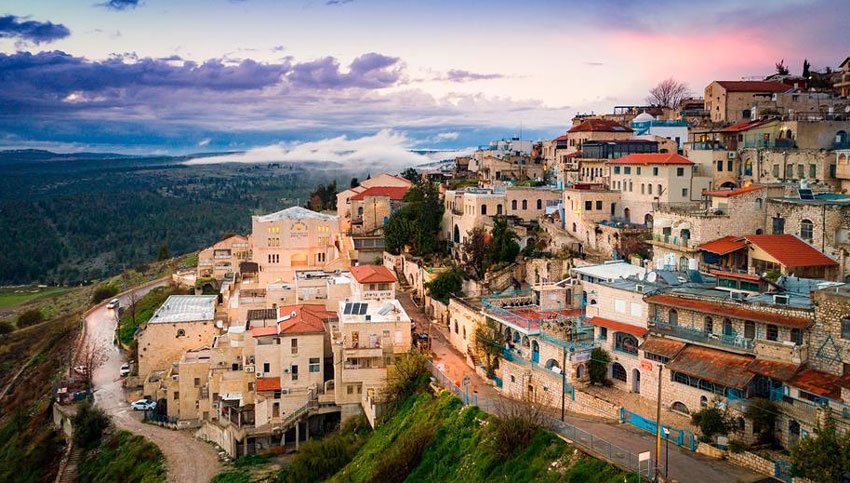
Tzfat is not only one of Israel’s holiest cities, it is also the highest city in the Holy Land. Set in the dense pine forests of the Upper Galilee, overlooking Tiberias and the Sea of Galilee, Tzfat is a delicious blend of ancient grandeur and modern-day resort. For thousands of years, the ancient city of Safed was conquered and reconquered – always changing hands. Said to have been founded by one of Noah’s sons after the Great Flood, the city was inhabited by the local Semetic populations throughout the years. Josephus mentions Tzfat as Sepph, a fortified Jewish town in the Upper Galilee. Today, after years of conflict ranging from the Crusaders to the Mamlukes to the British, Tzfat survives – as pretty, vibrant and mystical as ever!
Ashkelon
Ashkelon is one of the most highly regarded cities in Israel, with roughly 149,000 residents and a population is that is constantly growing. This dynamic city boasts a high quality of life, with excellent educational institutions, rich and varied leisure activities for the entire population with many recreation spots located around the city. Ashkelon is just south of Ashdod and about one hour’s drive from Jerusalem. You’ll find a beautiful Sea Park located on Delilah Beach, next to the marina with its new large commercial center, cinema, cafés, and restaurants. In Tel Ashkelon National Park, you can enjoy an entertainment and camping experience with a view of the Mediterranean Sea. Ashkelon is a place where past and present blend perfectly into a modern, groundbreaking and progressive city, with a blended mix of Jews at all levels living together. This warm and wonderful community will always welcome you. Living in a beautiful city, inside and out make Ashkelon a place that it’s easy to fall in love with.
Neve Daniel
Neve Daniel is located about 18 kilometers (11 miles) southwest of Jerusalem. It is situated atop one of the highest points in the area, and offers views as far as Tel Aviv to the west and the mountains of Jordan to the east. The settlement is under the administration of the Gush Etzion Regional Council. The population has grown rapidly, and includes Olim from a variety of countries, including a significant percentage of English speakers. The majority of residents are Orthodox, and English speakers generally show a high level of interest in integrating with greater Israeli society.